skip to main |
skip to sidebar
"I remember the fear, of never feeling safe. You had to hide constantly. And the hunger -- I would sit in our apartment and look out the window, and I would see the Polish children across the street bringing milk back home. It was like watching people in a storybook -- we had no food, no milk."
--Nelly Cesana
The uprising of the Warsaw Ghetto help start the uprising of the city of Warsaw, in which the Poles fought the Germans in hopes of freeing their capital. This act of courage and rebellion inspired many people across the world--including me. I feel it must take a huge amount of bravery to stand up to one of the most ferocious armies known even to this day. Even though these people were sick, starving, and dying, they knew they would rather die in hopes for the future than burn in a Nazi camp. They should be remembered because people should keep in mind that even in the worst of situations there is always a way to free yourself. In this case they were not physically freed by their rebellion, but their minds and spirits sure were. I believe it is awful for human beings to have to be in this terrible situation in the first place, but I think the people of Warsaw made the best of it that they could. They continued their religious and cultural practices even after the Nazi's tried to take them away. I believe that in a case this severe a loss of human life, be it the rebel or the person trying to control them, can be justified if it paves a path for a better tomorrow. If I were in this situation I would love to say I would have easily joined the fight, but in all honesty I do not know for sure if I would have. What they did was not an easy thing to do, and although in literal terms they 'lost' the battle, in spiritual terms I can easily say they won.
[Quote from http://www.jweekly.com
www.jweekly.com/article/full/19799/warsaw-ghetto-survivor-recalls-hunger-fear-
and-grief/]
On January 18, 1943 the Germans were planning to begin the second deportation of the Jews. This led to the first armed clash with the Jewish insurgency. The clash was headed by two major underground resistance groups, the Jewish Combat Organization and the Jewish Military Union. They led a sudden attack on the German forced which succeeded in halting the deportations a few days. Even when they did occur, only 5,000 Jews were sent away instead of the original 8,000 planned. The remaining hundreds of people remaining in Warsaw, including children, were ready to fight. They were armed simply with handguns, some revolvers, gasoline bottle bombs, and a few other weapons that the resistance groups had smuggled in.
Support from outside the ghetto was scarce, but Polish Resistance units from Armia Krajowa (the Home Army) and Gwardia Ludowa (the People's Guard) attacked German units near the ghetto walls. They smuggled weapons, ammunition, and other supplies to the fighters.
On April 19, 1943 the police and SS forces entered the ghetto, planning to complete their 'action' within three days. However, they suffered great losses from an ambush by the Jews, who shot hand grenades and other explosives at the troops from windows, alleyways, and sewers. In the afternoon later that day two young boys raised the Polish flag and the blue-and-white banner of the Jewish Combat Organization, symbolizing their resistance. Despite many attempts by the German forces, the flags stayed put for four whole days. Because of the fighting the JCO lost all of its leaders, and on April 29th the remaining organization members escaped to through a tunnel and relocated to the nearby Michalin forest.
The remaining Jewish civilians and surviving fighters took shelter in bunker dugouts which were hidden amongst the ruins of the ghetto. Smoke grenades, tear gas, and even poison gas were used to force the people out of hiding. In many cases the people came out firing, or blindsided the soldiers after have seemingly surrendered. On May 8, 1943, the Germans discovered the JCO's main command post. Dozens of the remaining resisters were killed, while others committed mass suicide by taking cyanide pills.
The uprising was officially ended on May 16, 1943. No matter, shooting could still be heard throughout the ghetto well into that summer. Approximately 13,000 Jews were killed in Warsaw during the uprising. Most of the remaining 50,000 residents were captured and shipped to their deaths at Treblinka. Although the Warsaw Jews still went down, they went down fighting. Which of these two possible deaths seems like more of a victory to you? This is a true example of a group of people who refused to be taken advantage of.
[Information from Wikipedia 12.07.09
http://en.wikipedia.org/wiki/Warsaw_Ghetto_Uprising]
Between July 23 and September 21 of 1942 over 254,000 ghetto occupants were sent to and murdered at Treblinka. By the end of the year it was clear to the remaining Jews that these deportations surely meant death. Many of them decided to finally stand up and fight.
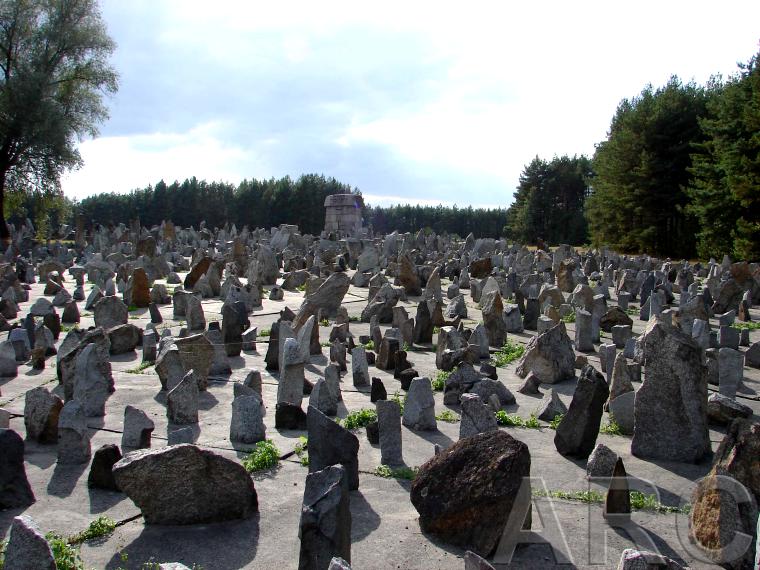
The Treblinka extermination camp was mentioned in my previous blog, but it means nothing to those who don't know the kind of horror that happened there. What kind of place could be so terrible that a group of sick, starving prisoners would rather stand up to their captors and risk death than go to? Treblinka was definitely that bad, if not worse. An estimated 85,000 people (99.5% of which were Jews) were killed there in just a little over a year. It was located about 62 miles northeast of Warsaw. This camp was not a typical 'concentration camp', as you have probably learned much about before. Treblinka was created simply for ending human life as quickly and in as large of a mass as possible.
The road from the railway was lined with barbed wire fences and lead directly to the gas chamber building, which trapped the prisoners in a room that slowly filled with the poisonous gas Zyklon B. After the people were killed, their bodies were brought to a pit behind the building. This pit was one meter wide by twenty meters long, which burned fires inside. There were rails placed over the pit on which the bodies were set to burn. At the very beginning of the camp the dead were buried in mass graves because the workers did not have time to burn them all. The stench of decomposing bodies could be smelled up to 10 kilometers away. Many Jews waiting in the railway guessed correctly that this same fate would happen to them, and many chose suicide over death at the hands of the Nazis. Now tell me, if you knew your fate was to be sent to a place like this, would you follow it? Or would you stand and fight, like the brave people in Warsaw did?
[Information from Wikipedia 12.04.09
http://en.wikipedia.org/wiki/Treblinka_extermination_camp]